JEV vs. GPT-4o on Instruction Following
JEV judges compliance; GPT-4o generates text that may or may not comply.

JEV and GPT-4o both get called "instruction-following" models, but they aren't doing the same job. JEV judges whether a given piece of state satisfies a typed question. GPT-4o writes the text that either satisfies the rubric or doesn't. Confusing the two produces bad headlines and worse deployment decisions.
Instruction following for JEV and GPT-4o
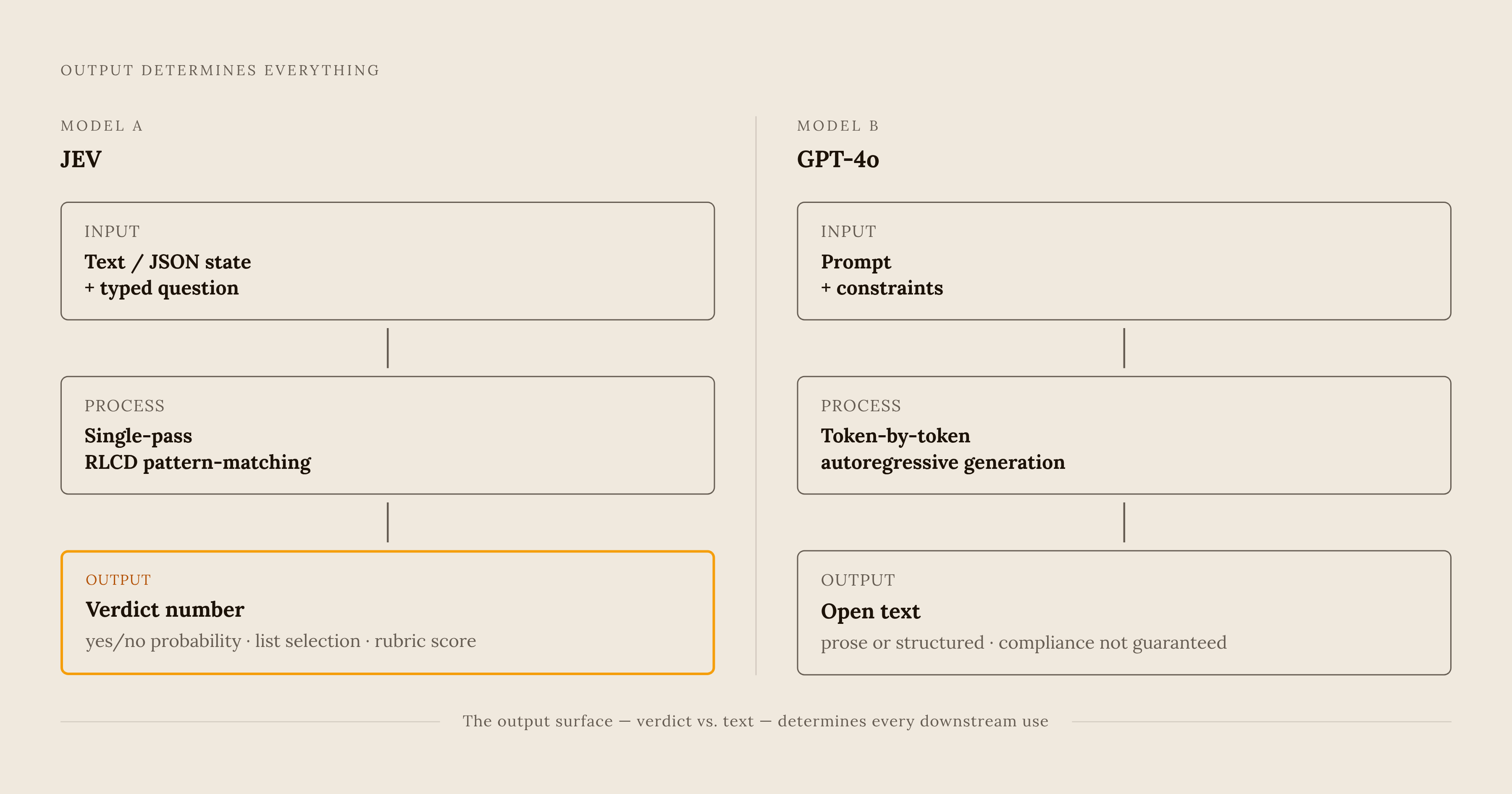
The term hides two different tasks under one label. There's the task model's job: take a prompt with constraints and generate output that actually complies with them. And there's the judge model's job: look at someone else's output and decide, correctly, whether it met the bar. GPT-4o gets measured as a task model. When benchmarks ask whether GPT-4o follows instructions, they're checking its generated text against the rules it was handed, things like format, word count, forbidden terms.
JEV gets measured on the other axis almost exclusively. It doesn't generate a cover letter or a code sample. It looks at a piece of state, text or JSON, and returns a verdict on whether that state satisfies some typed question. So when a benchmark says JEV performed well on an instruction-following task, it means JEV correctly classified compliance, not that JEV produced compliant text itself.
This is the entire point of comparing them. It's the entire point of comparing them. Skipping past this distinction produces claims like "JEV beat GPT-4o," which misunderstands what each model was built to do, or "GPT-4o is better because it can write," which misses that writing was never JEV's job. Get the distinction straight first, and the rest of the comparison actually means something.
Trade-offs of JEV's single-pass architecture
JEV doesn't produce prose. Feed it a piece of state, text or structured JSON, along with a typed question, and it returns a decision: a yes/no probability, a selection from a fixed list of choices, or a position on a rubric scale. That's the entire output surface. No preamble, no explanation, no hedge.
The training process reflects that constraint. Instead of standard next-token prediction, JEV trains through something TypeSafe calls Reinforcement Learning for Calibrated Decisions, RLCD for short, built around producing well-calibrated probabilities rather than fluent continuations. TypeSafe's own framing calls JEV a "System One model," borrowing the fast, intuitive judgment metaphor rather than the slower, deliberative kind. It's a useful shorthand: JEV isn't reasoning its way to a verdict through visible steps, it's pattern-matching against a schema and outputting a calibrated number.
That architecture buys real advantages. Skipping autoregression means no token-by-token generation latency, and it structurally eliminates hallucination; JEV can't produce a text it wasn't asked to produce, because it isn't producing text. But the same design gives something up. There's no chain of thought. No rationale. If a JEV verdict looks wrong, there's no scratch work to check, only a probability and a label. That trade-off defines everything about where JEV works and where it doesn't.
How GPT-4o approaches instruction following through autoregressive generation
GPT-4o builds its output one token at a time, attending across the full context window at every single step. Instruction compliance, under this design, isn't enforced by any external schema. It emerges from the generation process itself. It's only ever as reliable as the generation happens to be on that particular pass.
The benchmark numbers bear that out. On IFEval, which checks verifiable, rule-based instructions like format constraints and length limits, GPT-4o scores 81.0%. GPT-4.1 scores 87.4% on the same benchmark, a gap that tells you OpenAI itself treats this as an active area for improvement, not a solved problem. Multi-turn settings show a similar pattern: on MultiChallenge, which tests whether a model keeps following instructions across a whole conversation rather than just one exchange, GPT-4.1 beats GPT-4o by 10.5%. Retaining instructions turn over turn is a documented soft spot in the GPT-4o generation specifically.
Rubric-level judgment tells a harder story still. RUBRICEVAL, a benchmark built from 3,486 rubric-level judgment instances, finds GPT-4o scoring only 55.97% on its HARD subset. That's a model widely used as a judge, falling well short of reliable on complex, semantically nuanced criteria. This isn't a knock on GPT-4o specifically so much as evidence that rubric-level compliance, judged well, remains a genuinely unsolved problem across the field.
Benchmark results on JEV as a judge on instruction-following tasks
A CMU paper tested JEV against sixteen generative and reward-model judges, with blinded human adjudication deciding who got it right. On ordinary preference judgments and evidence-grounded factuality checks, JEV lands within three percentage points of the strongest comparator in the study, at roughly 0.36% of that comparator's fee. That comparator is identified in the paper as GPT-6, not GPT-4o. GPT-4o's role in this research is narrower: it supplies one of the evaluation splits, 350 pairs from JudgeBench spanning knowledge, reasoning, mathematics, and coding.
So the accurate claim is that JEV performs competitively against a top-tier judge model on straightforward preference and factuality tasks, at a tiny fraction of the cost. That's remarkable on its own terms. It is not evidence that JEV outperforms GPT-4o head to head.
Checking a mathematical or logical derivation, and resisting an answer that's wrong but elaborately, confidently written, is where JEV runs into trouble. Style-adversarial pairs from RM-Bench expose this limit most clearly. In these cases, JEV's confidence score doesn't do a good job of flagging when the verdict itself is off, the model can be just as confident when it's wrong as when it's right. RUBRICEVAL helps explain why this happens: GPT-4o itself only reaches 55.97% on HARD rubric instances, so judging complex, adversarial content is hard in some fundamental sense, and JEV's single-pass structure gives it no mechanism, no scratch space, for reasoning explicitly through a derivation before committing to an answer.
What the calibrated-escalation solution implies about choosing a judge
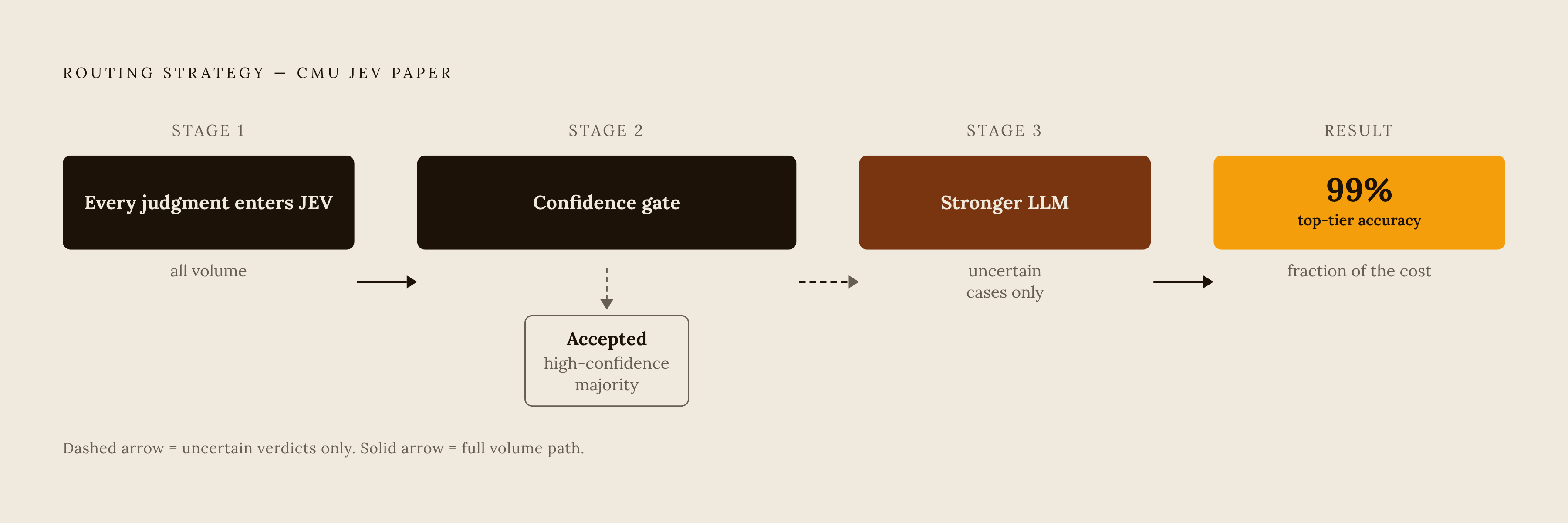
The CMU paper's most actionable finding is a routing strategy. It's a routing strategy. Build a frozen cascade that accepts JEV's confident verdicts outright and escalates only the uncertain ones to a stronger LLM, and the resulting system retains 99% of the stronger model's accuracy, at a fraction of what running the stronger model on every single case would cost.
That works because JEV's confidence output isn't decorative. On the judgments in the study, the probability JEV attaches to a verdict functions as a genuinely usable signal for deciding what needs a second opinion and what doesn't.
There's a catch, and it's not a small one. The confidence threshold that decides when to escalate has to be validated locally, for each workload and each fallback model in the cascade. A threshold tuned on preference tasks won't transfer cleanly to style-adversarial pairs or derivation-heavy math problems. Skipping that validation step brings the cascade's efficiency gains with a hidden accuracy cost nobody measured.
DeepEval's tooling makes the pattern concrete rather than theoretical. DeepEval supports JEV as the judge behind its metrics, under what it calls system_one eval mode: JEV handles the high-confidence decision step, and generative models get reserved for the escalations that actually need them. The result cuts variance, latency, and cost from the evaluation pipeline, without discarding the reasoning capability that generative models bring to the cases that genuinely require it.
GPT-4o's generative architecture advantages over JEV
Explanation is the clearest one. GPT-4o can say why an instruction was or wasn't followed, walking through its reasoning in plain language. Compliance work, audit trails, anything user-facing where a person needs to understand a decision rather than just receive it, that all depends on rationale. JEV has no equivalent. It hands back a probability and a verdict, and that's where the interaction ends.
Open-ended instruction compliance is GPT-4o's native territory in a way JEV structurally cannot enter. Asking for a cover letter that reads formal without sounding stiff, under 200 words, requires a model that generates prose and judges its own compliance implicitly through the act of writing. JEV has no output surface for that task at all, there's no rubric slot for "sounds formal but not stuffy."
Reasoning-heavy derivation checking is where the CMU paper's gap between JEV and stronger judges concentrates most sharply, in verifying multi-step logic and resisting misleading-but-confident answers. These are exactly the tasks where a longer chain of thought earns its keep, where the extra reasoning tokens spent are worth the cost because the problem actually requires working through steps, not pattern-matching against a schema. And multi-turn conversation, despite GPT-4o's documented instruction drift over long exchanges, still plays to its strengths relative to JEV, which receives discrete snapshots of state and has no native way to carry context from one turn to the next the way a conversational model does.
Matching each model to its built-for task type
Reach for JEV when the question is closed-ended and the answer space is typed, a yes or no, a score against a rubric, or a class picked from a fixed list. It's also the right call when volume is high enough that latency or per-call cost adds up fast, continuous evaluation pipelines, regression suites, routing decisions running at high throughput. Policy changes that need to take effect immediately, without a retraining cycle, are a good fit too; MindStudio's routing tests show policy updates applying in real time under this kind of setup. And whenever hallucination is unacceptable and a prose answer was never the goal, JEV's structural inability to generate unconstrained text becomes a genuine asset rather than a limitation. None of this comes free, though: it only works if the team is willing to actually validate thresholds rather than guessing at them.
Reach for GPT-4o, or another generative model, when the output itself has to be prose, when the instruction-following task is a generation task by definition. Reasoning transparency belongs on this side of the ledger too, whenever a user or an auditor needs to see the "why" behind a judgment rather than just the "what." Derivation checking, mathematical reasoning, resisting an elaborately wrong answer, these all lean on chain-of-thought allocation in a way JEV's architecture doesn't support. Multi-turn conversation, where context has to persist across an entire session, fits here as well.
For teams whose workload spans both regimes, there's a third option: the cascade. JEV handles the confident calls, a generative model catches the escalations, and the CMU paper's cascade held onto 99% of top-tier accuracy at a lower overall cost. The one condition that can't be skipped is threshold validation, done per workload, since a setting that works for preference judgments won't automatically hold up on style-adversarial or derivation-heavy tasks. DeepEval's hybrid and system_one eval modes, along with LiteLLM's evaluate endpoint and its logging, are the current production paths for running this pattern today.