JEV Version History and Capability Progression
How five architectural stages transformed a simple evaluator into a production rule engine.

JEV’s capability progression is best understood as a dependency chain, with each addition extending the expression model that came before it. The supplied notes describe that progression but give no release numbers, dates, or supporting software documentation. This article follows the order in which the notes say capabilities were added, with no verified version history to draw on.
What JEV is and why its version history is worth tracing
The brief describes JEV as an expression evaluator that evaluates expressions against variable bindings. Its proposed history follows the problems that emerge as expression use grows from simple configuration to more complex applications. Instead of treating the platform as one fixed collection of features, the account distinguishes the evaluation foundation from the capabilities later built upon it. Exact release attribution remains unavailable, so the milestones below identify architectural stages.
The foundational design choices made before the first public release
The foundational choice described in the notes was to establish a small evaluation model before adding capabilities that changed how expressions could be composed, isolated, or checked. Starting small made the model easier to check and easier for teams to begin using. Under that approach, later additions had to fit the existing evaluation contract so adopters could keep using it.
That choice also explains why the proposed sequence separates capabilities that might now seem inseparable. Functions introduce reusable logic, but reuse raises questions about where variables belong. Scopes address that problem, while deferred evaluation introduces a different question about when an expression needs to run. The notes do not specify the original implementation or pre-release decisions in greater detail, so this foundation is a design rationale.
Early versions and the core expression-evaluation model they established
The earliest stage established a stable relationship between an expression, its bindings, and its result. The notes state that, given the same bindings, an expression always produced the same result, and that later releases preserved this contract. This was the base for subsequent expansion. Adopters could build on a defined evaluation model while later capabilities changed the ways expressions were organized and used.
The early model is described as using a flat namespace and eager evaluation. Those limits kept the early model small enough to reason about, with no nested variable contexts or deferred work. For simple configuration expressions, the notes identify this stage as sufficient and as having the lowest integration cost. More capability was not automatically more useful. Where expressions remained small and self-contained, the later architectural layers answered problems that those applications had not yet encountered.
The brief does not list all the early syntax, operators, or supported values. Nor does it identify individual early releases. The next milestone expanded composition without replacing that foundation.
The version that introduced user-defined functions and why it changed how JEV was used
User-defined functions mark the first major expansion in the supplied progression, although the brief does not identify the release that introduced them. Their significance was the ability to give domain logic a name and reuse it within other expressions. Composition became part of the expression environment itself. Instead of maintaining isolated strings, teams could organize related logic as layered function calls.
A hypothetical eligibility rule makes the difference concrete. Before this capability, a condition such as “customer is eligible if tier is gold and balance exceeds threshold” would appear within a single expression string. With user-defined functions, the same condition could become a named predicate called by other expressions. The example illustrates reuse at a conceptual level. Its architectural point is that a business condition can become a shared unit rather than text repeated wherever that condition is needed.
The notes link this change to teams building rule engines, which could keep libraries of named business-rule predicates. In the proposed history, JEV grew from a tool for read-once configuration evaluation into a reusable expression library. Once expressions could call shared logic, a flat namespace was a poorer fit as evaluation became more nested.
Scoped variable namespaces and what they made possible for nested evaluation contexts
Scoped namespaces addressed the collision risk that accompanied reusable functions and growing expression complexity. The notes describe a parent expression that sets up shared bindings while branches of a rule tree evaluate within their own child scopes. Siblings remain isolated from one another’s local variables. This made nested evaluation contexts a supported structure rather than a collection of expressions competing for the same names.
The practical consequences extend beyond function calls. An iterative expression over a collection can use a loop variable within each iteration without leaking that variable into the enclosing scope. A conditional branch can likewise define a locally relevant variable without exposing it in a sibling branch’s evaluation result. These examples describe the boundary scopes provide. The brief does not give detailed lookup precedence or rules for handling every possible naming conflict.
The architectural gain was a way to separate shared context from local work. That separation becomes more important when expressions no longer run as one flat sequence, because each nested part still needs an appropriate variable context. The notes position scopes as a prerequisite for later lazy evaluation and streaming capabilities. They provide no streaming milestone or implementation details, but the intended dependency is explicit.
Starting small made the model easier to check and easier for teams to begin using.
Lazy evaluation support and the performance implications for large expression graphs
After scopes, the next bottleneck in the proposed sequence was eager evaluation of large expression graphs. Lazy evaluation targeted when work was performed, rather than redesigning the underlying expression model. Not every branch needs to be evaluated. In expressions with many branches that terminate early, including boolean short-circuit logic, the notes describe a reduction in evaluation work proportional to the branches that can be skipped.
The architectural distinction is between an expression being present in the graph and its result being needed for the outcome. Under the lazy model described by the outline, those are no longer equivalent reasons to perform evaluation. This changes the work an evaluation requires without changing the purpose of the expression. Scopes remain relevant because deferred work belongs to a context, rather than to an undifferentiated pool of variable names.
The brief leaves JEV’s representation and execution of deferred expressions and the release number for this milestone unspecified. Those gaps prevent a more specific implementation account, but they do not obscure the workload distinction. Large branching expressions allow work to be skipped, but there is less work to skip when an expression needs every part of its graph.
Type-system extensions that reduced runtime errors and improved tooling support
Type-system extensions move the focus from how expressions behave at runtime to what can be checked before they run. The notes present this milestone as the point at which larger expression libraries could support stricter correctness requirements. Errors could show up before runtime tests found them.
That shift also expanded what development tools could do. The brief describes IDEs and static analysis tools reasoning about JEV expressions without running them, with autocompletion and type-error highlighting inside expression strings. The notes do not specify supported types or checking rules. Consequently, they do not support claims about which individual errors the type system could detect.
Teams with many contributors could enforce type contracts across an expression library without relying only on runtime test coverage to find mismatches. This is a different concern from reducing evaluation work. Lazy evaluation skips work that does not need to run, while type information helps find uses that are incompatible. Together, they describe a platform becoming more suitable for codebases in which expression correctness must be maintained across both contributors and integration boundaries.
Integration APIs and the versions that made JEV embeddable in frameworks beyond vanilla Java
Integration APIs extended the progression from the engine’s internal capabilities to the way other software could embed it. The brief identifies workflow frameworks, rules engines, and configuration-management frameworks as the relevant categories. In that model, callers interacted with the host framework’s API while JEV remained an implementation detail. The host supplied the application-facing boundary. This allowed the expression layer to be embedded with minimal coupling, as described in the notes.
A library exposes capabilities for an application to call directly, while an embedded expression layer can operate behind the framework through which callers already work. The notes frame this as JEV becoming an ecosystem component. Its functions, scopes, evaluation behavior, and type contracts would then support both direct library integration and uses mediated by another system.
However, the integration section of the brief leaves the specific API surfaces unnamed. It supplies neither interface names nor the versions in which they appeared, and it does not establish framework-specific compatibility. The defensible conclusion is narrower but useful. Integration APIs are the proposed milestone at which the engine’s accumulated capabilities became available through host frameworks without requiring callers to interact with JEV directly.
How the cumulative additions interact as a coherent capability stack, not independent features
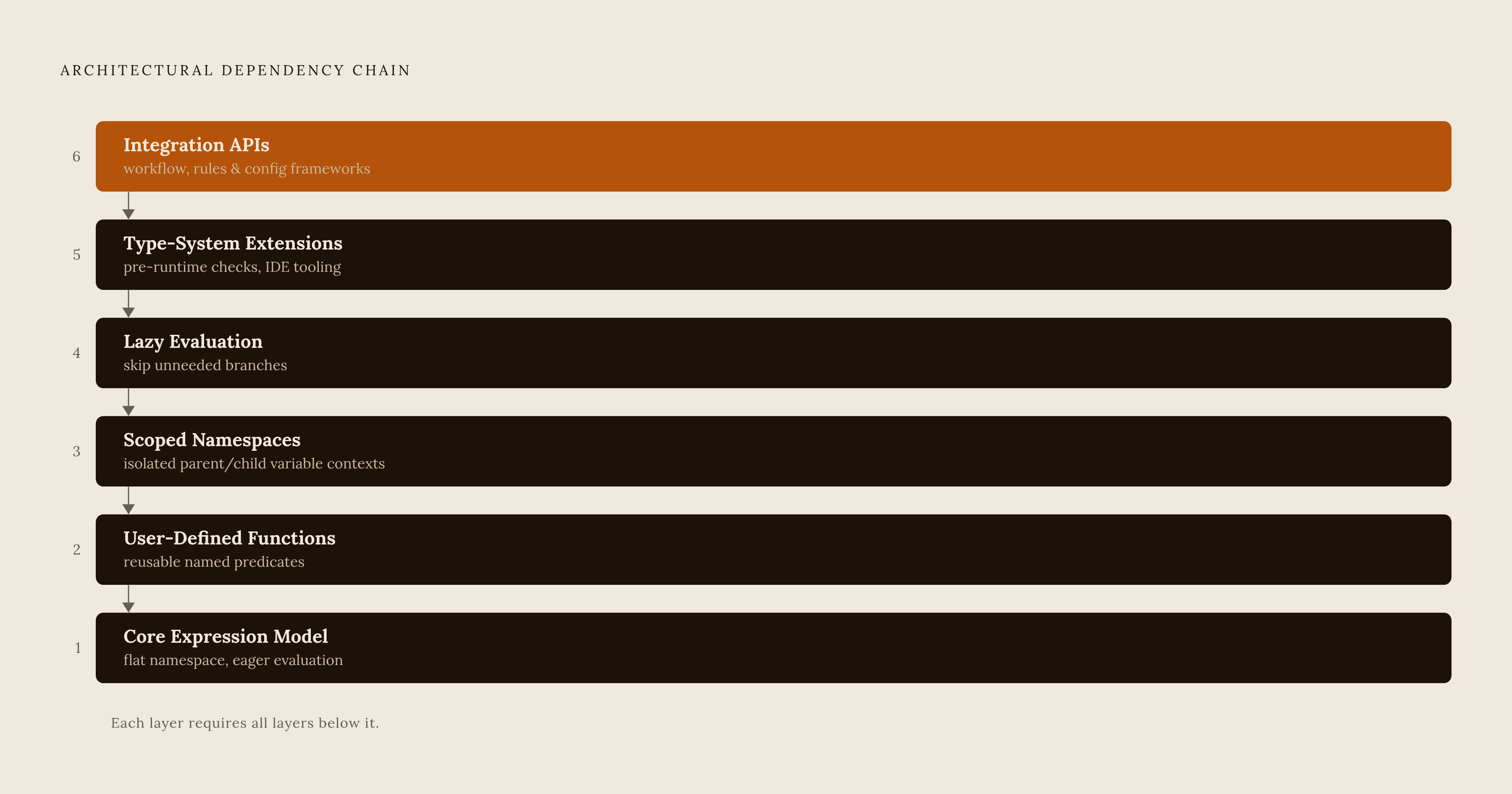
The evaluation contract supplies the stable base, functions make logic reusable, and scopes give nested uses separate variable contexts. Lazy evaluation then changes which work must run, while type extensions make more errors visible before execution. Integration APIs let other software use all those capabilities.
For adoption decisions, the lesson in the brief is to match the required capability layer to the application. Simple configuration expressions can use the early flat-namespace, eager-evaluation model. Uses in rule-engine and policy-evaluation systems need the function-plus-scope layer described in the notes. Large expression graphs whose performance matters call for lazy evaluation, while environments with many contributors or built-in tooling call for type-system extensions.
The notes characterize upgrades as additive and sequential because later capabilities depend on earlier foundations. Actual upgrade paths cannot be inferred without release documentation. A team looking at a version needs to check both what it can do and which migration steps are needed to get to it.
The missing version identifiers prevent this account from serving as a release-selection reference on its own. They do not erase the central design question it exposes. A useful version history connects each addition to the problem it addressed and the foundation it required, giving adopters a map of design intentions.