JEV Tokenization and Language Coverage
Jev's tokenization handles multilingual input but limits state to 32,000 tokens per request.

Jev's tokenization pipeline is what lets it take in messy, multilingual program state and hand back a typed decision instead of a wall of text. Knowing exactly how that pipeline works, and where its language coverage actually holds up under testing, tells a developer precisely when to trust the model and when to check its work by hand.
Jev's output model breaks from standard LLMs
The founding team is Diogo Almeida, Erik Gafni, and Sasha Sheng, with Almeida serving as CEO after a stretch at OpenAI, where he worked on RLHF, InstructGPT, ChatGPT, and GPT-4. That background matters, because Jev is in some ways a rebuttal to the very training paradigm Almeida helped build.
Jev does not generate text. It returns typed values, probability estimates, and confidence scores, meant to be read by software, not by a person scrolling a chat window. The framing draws a clean line: large language models operate in System 2 territory, generating output slowly and deliberately, one token stacked on the next, while Jev is built for fast, narrow, repeated decisions where every possible answer is already known before the request is made.
The architecture is transformer-based, but TypeSafe has not published details beyond that, and outside speculation about what's actually running has not been confirmed by anyone at the company. That deserves more than papering over. The name itself nods to William Stanley Jevons, the economist who studied how falling costs expand use rather than shrink it: once a decision gets cheap and fast enough, it appears in places where calling a large model would have felt like overkill.
So Jev takes in input the same way a language model does, through tokenization, but produces output through an entirely different mechanism. That tension, ingestion looking familiar while generation looks nothing alike, is the hinge the rest of this piece turns on. TypeSafe AI, a San Francisco company founded in 2024, released Jev in limited early access on September 15, 2026, backed by a US$40 million seed round led by DCVC Jev: TypeSafe's System One Model That Never Hallucinates. TypeSafe calls this class of model a "System One model," a name drawn from Kahneman's fast, intuitive System 1 thinking in Thinking, Fast and Slow.
Tokenization in Jev: ingesting input without using it to generate output
The distinction to establish here is that LLMs sit in System 2 territory, slow, deliberate, and autoregressive, while Jev is positioned for fast, narrow, repeated decisions where the possible outputs are defined in advance. On the input side, Jev runs standard transformer tokenization to build a representation of whatever it's been handed. On the output side, there's no autoregressive generation at all, no token-by-token prediction chain building a sentence. Instead, Jev evaluates every question in a request in one parallel pass and returns typed values directly. The tokenizer's machinery is present for comprehension. It is simply absent from production.
What can Jev actually read? Plain strings, JSON objects, or JSON arrays of text, with no special format required. TypeSafe recommends structured objects for anything beyond trivial requests, so the relationships between pieces of context stay explicit rather than implied. The company uses the word "state" for the full bundle Jev evaluates, essentially everything a developer would put in front of a panel of human experts before asking them to render a judgment. That's a helpful mental model: state is not a prompt, it's a case file.
The training method that produces all this is called RLCD, Reinforcement Learning for Calibrated Decisions. This differs from the two techniques most people already associate with modern model training. RLHF optimizes for output humans prefer to read. RLVR optimizes for output that's verifiably correct against some ground truth. RLCD optimizes for something narrower and, arguably, harder: calibrated probability. If Jev assigns a 0.9 confidence score across a hundred separate inputs, roughly ninety of those should turn out correct. Almeida confirmed this distinction himself on Hacker News, which carries some weight given he helped pioneer RLHF in the first place. Calibration isn't a feature bolted onto Jev through clever prompting. It's the thing the model was built around. The key distinction, captured by an early observer at nerdy.dev on September 17, 2026, is that Jev has "the tokenization LLM powers to breakdown input (token window) but without the word vomit" Jev: TypeSafe's System One Model That Never Hallucinates.
The token window and the consequences of exceeding the budget
Jev's context window runs to 64,000 tokens total, with a state budget of 32,000 tokens per request Jev: TypeSafe's System One Model That Never Hallucinates. Those two numbers interact in a way that trips people up if they're not paying attention. Every question asked in a single call, combined with state, has to fit inside the 64,000-token bound Jev: TypeSafe's System One Model That Never Hallucinates. State plus the single longest individual question has to fit inside the 32,000-token bound. State itself only gets counted once per request, no matter how many separate questions ride along with it.
In practice, the 32,000-token ceiling is what governs long conversations or dense case files Jev: TypeSafe's System One Model That Never Hallucinates. The 64,000-token limit only becomes the binding constraint when the questions themselves balloon in size. Push past either budget and the request doesn't degrade gracefully, it fails outright, throwing a ModelHTTPError with a max_tokens_exceeded code. For the current release, jev-1.13, rate limits are 250,000 tokens per second and 1,200 requests per minute, and jev-latest currently resolves to jev-1.13.0, a pointer that will shift the moment a new version ships.
A 32,000-token state budget doesn't translate to the same number of characters across every language Jev: TypeSafe's System One Model That Never Hallucinates. Scripts with larger character sets relative to how tokenizers draw their boundaries can burn through that budget far faster than English text of comparable length. This constraint matters more for multilingual deployments than for English-only ones. Practitioners should measure token consumption using their actual model, their actual input format, and their actual language before planning capacity, not infer it from English examples.
The three question primitives that shape what Jev can decide
Choice picks one option from a defined set of up to 255 entries, and Jev cannot return an option not in the schema. Score assigns an input to a position on an ordered scale, with rubric tiers the caller defines up front. Noul handles yes-or-no questions and returns a probability between 0 and 1, with no separate confidence field attached.
All the questions inside a request get evaluated independently and in parallel. One answer never leaks into another as context, so context rot does not occur the way it does when a language model has to hold too much shared conversation in its head at once. A practical side effect: stacking more questions into a single request barely moves the response time, since the model isn't working through them one after another, it's working through them all at once.
The design guarantees the type in a way that holds up, but it's narrower than it sounds. Because every valid output is defined in the schema before the call ever runs, Jev cannot produce a structurally invalid answer, and TypeSafe reports a 0% structured output error rate on that basis. That is a guarantee about shape, not about truth. Jev can pick the wrong option from its own schema with total confidence and still satisfy the type contract perfectly. No chat, no open-ended explanation, no code generation, no prose. Reach for Jev to write a paragraph and it's the wrong tool, full stop. There are three primitives, freely mixable in a single call.
TypeSafe's language coverage claims measured against the evidence
TypeSafe's comparison documentation claims coverage across more than 100 languages, though the same sources are upfront that reliability drops outside English. What's missing is any published multilingual evaluation from TypeSafe itself, and that gap matters a great deal for any business serving users in Hindi, Arabic, Spanish, Portuguese, or code-switching registers like Hinglish. A coverage claim on a model card is not the same thing as a tested benchmark.
The calibration evidence that does exist is thin and language-specific. That's a meaningful gap, and it says something real about Jev's calibration discipline. But it's one language, tested one way, and shouldn't be read as a stand-in for every other language Jev claims to cover. Separately, a Towards Data Science piece ran a test using 3,080 bank messages comparing Jev against Qwen, though the language those messages were written in isn't specified anywhere in the available material, so it can't be assumed either way.
Layer the token-budget limits back on top of this. Because character-to-token ratios shift by script, coverage of 100-plus languages doesn't mean equal token efficiency across all of them. A language can technically be "covered" and still cost a developer far more of the state budget to represent the same amount of information. The sensible posture here is to test Jev against real multilingual traffic before trusting it with anything outside English, since a coverage line in a model card carries no calibration guarantee on its own. Names, scripts, code-switching patterns, and domain-specific vocabulary each need to be checked on their own terms, not inferred from a headline number. In Supa Journal's Japanese benchmark on September 18, 2026, four chat models had confidence errors of 0.078–0.163 while Jev had 0.002–0.047 (a meaningful gap, but this is one language and one benchmark type).
Where Laya fits when English coverage is not enough
Laya arrived on September 18, 2026, just three days after Jev's launch, and it's an open model rather than a proprietary one. The distinction from Jev on this front is structural: Laya's multilingual claim is tied to a specific, named, inspectable artifact, rather than sitting inside a broader product-level assertion.
Laya isn't a drop-in replacement, though. It needs labeled examples and fine-tuning to hold up in a stable production task, so it demands more setup work than Jev's zero-configuration approach.
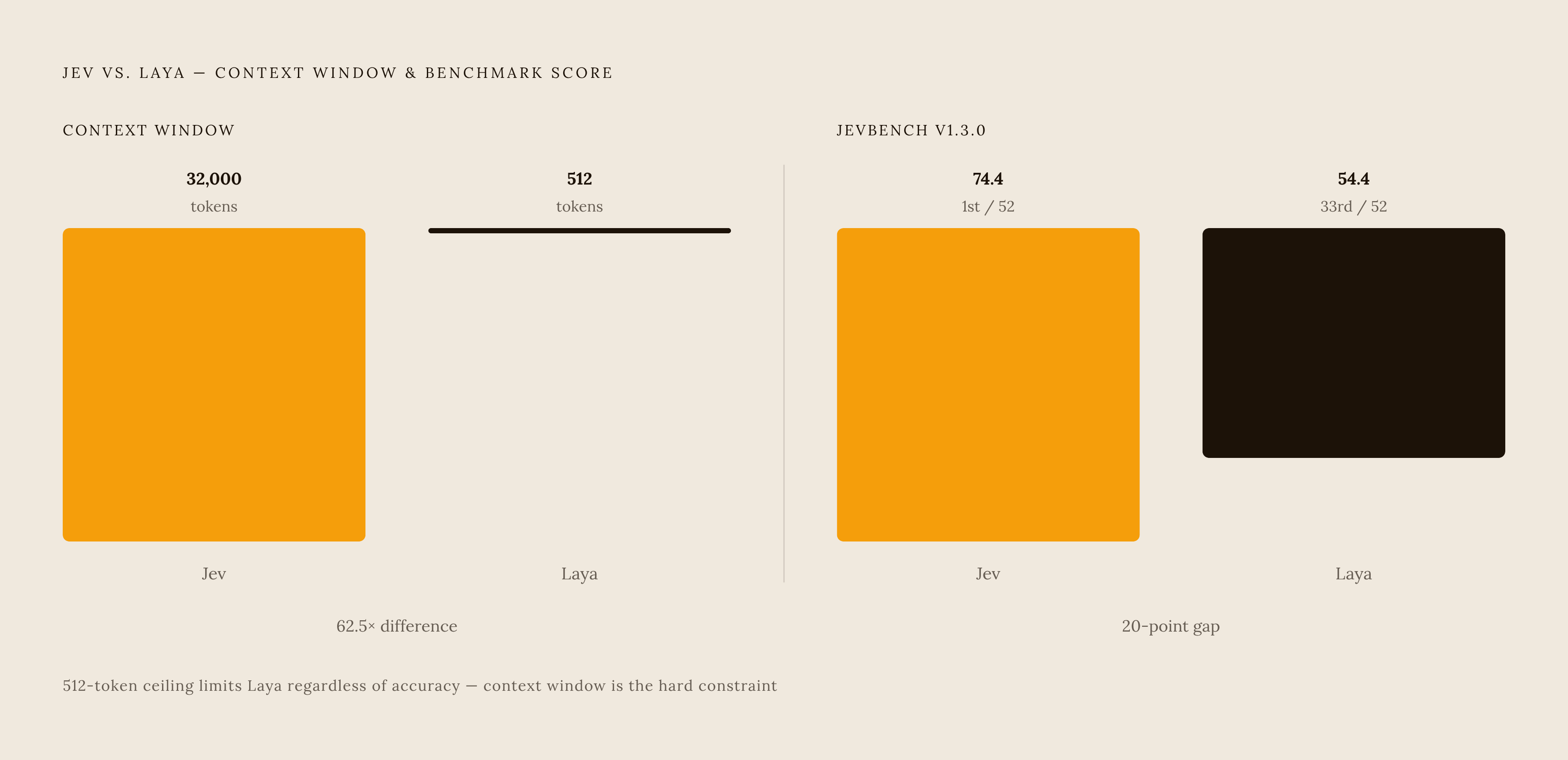
Jev pulls ahead once a request carries three or four questions or more, and it pulls further ahead on states longer than Laya's hard 512-token window allows, since Laya cannot consume long states while Jev has a 32,000-token state budget. That window is Laya's real ceiling: it simply cannot ingest long state, while Jev's 32,000-token budget makes it the obvious choice once context grows heavy.
On JevBench v1.3.0, checked September 22, 2026 across 534 typed decisions split between easy, standard, judge-style, and hard cases, Jev scored 74.4 overall and placed first, while Laya scored 54.4 and placed 33rd, a gap wide enough to matter. Language coverage never guarantees uniform quality across every language it nominally covers, and Laya's named multilingual checkpoint is a reason to actually go test it, not a reason to assume it will perform the same way in every script it claims to support. Names, code-switching, domain vocabulary: all still need separate testing, no matter which model ends up in production. Laya ships under Apache-2.0 with English or multilingual checkpoints, with the multilingual checkpoint being mmBERT-base at 322M parameters covering 100+ languages.
Other alternatives that appeared after Jev's launch
Within a day of Jev's release, a project called openjev reproduced its interface by reading option logits directly out of Qwen3.5-4B, and posts on r/LocalLLaMA pointed toward zero-shot classifier encoders like gliformer as another route to similar behavior. Neither one reproduces TypeSafe's actual training process or its calibration work, and TypeSafe's own founder has said the real moat here is training data, not architecture. Copying the interface is not the same as copying what makes the interface trustworthy.
Its published comparison with a Jev reference shows +0.45 points on one suite and a miss on Banking77 (very early signal, not a settled comparison). Separately, a model called Contrastive Language Model, CLM-8B, surfaced on September 23, 2026, described as an open System One model, though no real benchmark detail has surfaced alongside it.
On the integration side, Jev has already found its way into existing developer tooling. LangChain exposes it through a TypeSafeClassifier, passing state and questions straight into.invoke(), and Pydantic AI supports it as a decision model via TypeSafeModel, letting an agent produce structured output and trigger tool calls from it.
Accuracy and calibration benchmarks: what the numbers measure
Start with the spread rather than the headline. TypeSafe itself flags that its model-capabilities team built those workflows, and frames the multiple as likely being at the high end of what real-world use will actually deliver. That's an unusually honest caveat for a company to put in its own marketing.
An external benchmark from AY Automate, run across 791 labeled decisions, found Jev running 4.7 to 7.5 times cheaper than the two cheapest small models tested, and 40 to 49 times cheaper than GPT-5.6 Terra. Those numbers are meaningfully smaller than the launch-day multiples, largely because the test leaned on short prompts and minimal reasoning settings rather than the more favorable conditions of an in-house demo.
Accuracy is where the picture gets genuinely mixed, and it deserves to be reported that way rather than smoothed over. JevBench v1.3.0, spanning 52 systems and 534 decisions, put Jev at 74.4 overall and ranked it first. But TypeSafe's own internal four-workflow benchmark landed at roughly 68% accuracy, a number that sits closer to mid-tier language models than to frontier ones Medium. TypeSafe's own dashboard shows Jev trailing an unidentified comparator by 6.3 percentage points on aggregate, reaching 76.0% on some tasks and dropping to 61.7% on others. On a 400-item PriorBench classification test, Jev scored 95.9% against 77.2% for simple keyword rules, a clear win in that narrow setting Towards Data Science.
None of this should get confused with the 0% hallucination claim TypeSafe likes to lead with. That figure is a structural guarantee that falls out of schema design, not a measured accuracy result, and it says nothing about whether Jev picked the right answer. Jev can return the wrong choice from its own schema with total confidence and the 0% figure stays untouched, because it was never measuring correctness in the first place. That doesn't make the claim false. It makes it a claim still waiting on more outside scrutiny before anyone should treat it as settled.
Sources
- Jev: TypeSafe's System One Model That Never Hallucinates
- How JEV Can Assist Language Models in Agentic Systems | by Harisudhan.S | Sep, 2026 | Medium
- Jev · September 17, 2026
- Jev vs. LLMs: When AI Moves from Generation to Decision-Making | Towards Data Science
- Jev Pricing (2026): Cost Per Decision, Free Window, Math
- convaiinnovations/laya-multilingual · Hugging Face