JEV Architecture and Design Philosophy
Startup Jev abandons autoregressive generation to answer closed questions fast and calibrated.

Software rarely needs an AI to write anything. It needs a yes, a no, a category, or a number it can act on inside a conditional statement, and it needs that answer fast enough not to become the bottleneck in a pipeline that might run millions of times a day. Jev, from a startup, is built around a bet that the entire architecture behind large language models today is the wrong tool for that job, and that fixing it means throwing out autoregressive generation entirely rather than optimizing around it.
The problem every autoregressive LLM creates when software needs a decision
Most AI wired into production software is there to answer a closed question: is this transaction fraudulent, does this message violate a policy, which queue should this ticket land in. It's there to answer a closed question: is this transaction fraudulent, does this message violate a policy, which queue should this ticket land in. The standard way to get that answer out of a chat model is to write a prompt, wait while the model generates a reply one token at a time, get back a blob of prose or JSON, parse it, validate it, and only then let the program act. Every one of those steps adds latency, and every one adds a place where things break.
The lack of genuine confidence estimates underlies all of this and rarely gets named. When a chat model outputs the words "90% confident," it has not computed a 90% probability of being correct. It has generated a string of tokens that a training process rewarded because human raters liked answers that sounded assured. There's no calibration link between the number in the sentence and the actual likelihood the sentence is right. Yet fraud screening, content moderation, routing, and risk scoring get built on exactly this pattern all the time: pay for a round of token generation, then treat whatever confidence claim comes back as a number safe to hard-code a threshold against.
TypeSafe AI and the origin of Jev
TypeSafe AI was founded in 2024 and released into limited early access on September 15, 2026, alongside a $40 million seed round led by DCVC. The founding team carries an unusual amount of weight for a company this young. Diogo Almeida is credited as a co-inventor of RLHF and InstructGPT, the training methods that led directly to ChatGPT and GPT-4, and he's listed as a contributor on both the ChatGPT release and the GPT-4 technical report. Sasha Sheng joins from Meta's FAIR research group, and Erik Gafni previously co-founded the genomics AI startup Ravel after stints at Invitae and Freenome.
Almeida helped build the dominant paradigm behind today's chat models and is now publicly walking away from part of it. It's that he helped build the dominant paradigm behind today's chat models and is now publicly walking away from part of it. In a World's Fair 2026 talk originally titled "What's Next After RLHF?", Almeida laid out the argument that predates Jev's launch and frames its whole thesis: RLHF trains a model to produce answers a human rater approves of in the moment, which is a proxy for sounding right. It was never a proxy for being right in a way software can act on unsupervised. Jev is what happens when that gap gets treated as the central design problem instead of an acceptable cost.
The single structural inversion: parallel, schema-locked evaluation instead of sequential token generation
Every mainstream LLM, and every other well-known model besides, is autoregressive. The model writes a token, feeds that token back into its own input, and writes the next one. That chain is why longer outputs take longer to produce, and it's the entire reason streaming interfaces exist: users watch words appear because the model is still generating them.
Jev breaks the chain. It's non-autoregressive by design. It scores every allowed answer to a question in parallel rather than writing its way toward one. There's no token-by-token sequence to wait on and nothing to stream, because nothing is being generated word by word. The model evaluates the full set of permitted answers at once and returns a probability distribution directly. TypeSafe's published figures put a full bundle of questions at 70 to 500 milliseconds round trip, against 3 to 329 seconds on comparable chat deployments. That gap reflects something structural. It's the direct consequence of removing a sequential dependency that never needed to exist for closed-form questions.
Likely architecture: shared state, isolated question branches, direct probability readouts
TypeSafe hasn't published Jev's architecture. Outside observers suspect an open-weight LLM underlies it, though TypeSafe says training data is entirely synthetic and produced in-house. The most detailed independent look came from a researcher going by archerhume, whose September 17, 2026 investigation of jev-1.13.0 drew on 1,029 instrumented probe records, including 190 generated math items, plus 6,800 benchmark records.
The reconstruction that comes out of that work describes a causal transformer, likely using a sparse mixture-of-experts setup, repurposed away from text generation and toward decisions. Shared context, a document, a case file, whatever background the questions depend on, gets encoded once, layer by layer. If there's a lot of shared state and many questions riding on it, most of the computation happens a single time rather than getting repeated per question. Each question then builds its own representation in an isolated branch, using its own text, its allowed answers, and attention back to that shared state, but the branches can't see each other. A readout layer, trained on outcomes rather than on next-token prediction, converts each branch's final representation straight into answer probabilities. Nothing gets written out as text along the way.
The reason causal attention doesn't force sequential execution here comes down to what causal attention actually governs, which is what information a position is allowed to use, not the order operations happen in. During the prefill stage of any transformer, before generation starts, every input position is already known, so a layer can process all of them together. The token-by-token dependency appears once decoding starts, one output token predicting the next. Jev's design ends at prefill and the probability readout. It never enters a decoding loop, so the dependency that defines autoregressive generation simply doesn't arise.
Three primitives: the entire output surface Jev exposes
Jev answers three kinds of questions and nothing else. Noul returns the probability that a yes-or-no proposition is true, for cases where a binary condition needs testing. Choice picks exactly one option out of up to 255, for cases where one category needs to win out over the rest. Score places an answer on an ordered scale running from 2 to 10 levels, for questions where the underlying thing being measured is a spectrum rather than a category.
Every one of these returns a calibrated probability sitting alongside the answer, as a structured field. Context limits run to 64k tokens for shared state plus all questions combined, 32k for shared state plus the single longest question, and 255 as a hard ceiling on Choice options.
None of this is an early limitation waiting to be lifted. Fixing the output space in advance is what lets the model score across it in parallel. Widening that surface to open-ended text means there's no longer a finite set of answers to evaluate at once. The sequential dependency Jev exists to remove comes right back in through the side door.
RLCD: training the model so its confidence numbers mean what they say
TypeSafe calls its training method RLCD, Reinforcement Learning for Calibrated Decisions, and frames it as a direct answer to RLHF's shortcomings. Where RLHF rewards answers a human rater approves of, which is a proxy for sounding right, RLCD rewards a decision paired with a confidence score that tracks how often that decision turns out correct. One optimizes for approval in the moment. The other optimizes for a number that holds up statistically over repeated use.
The calibration target is specific: across a large group of cases where Jev reports 0.8, roughly 80% of those cases should turn out correct. That's the actual quantity the RLCD reward function is pointed at. Calibration, by its nature, is a property of a group of predictions, not a guarantee about any individual answer. A well-calibrated 0.8 does not mean any single flagged case is 80% likely to be right. It means that out of many cases scored that way, the hit rate should be near 80%.
The scope of the performance evidence
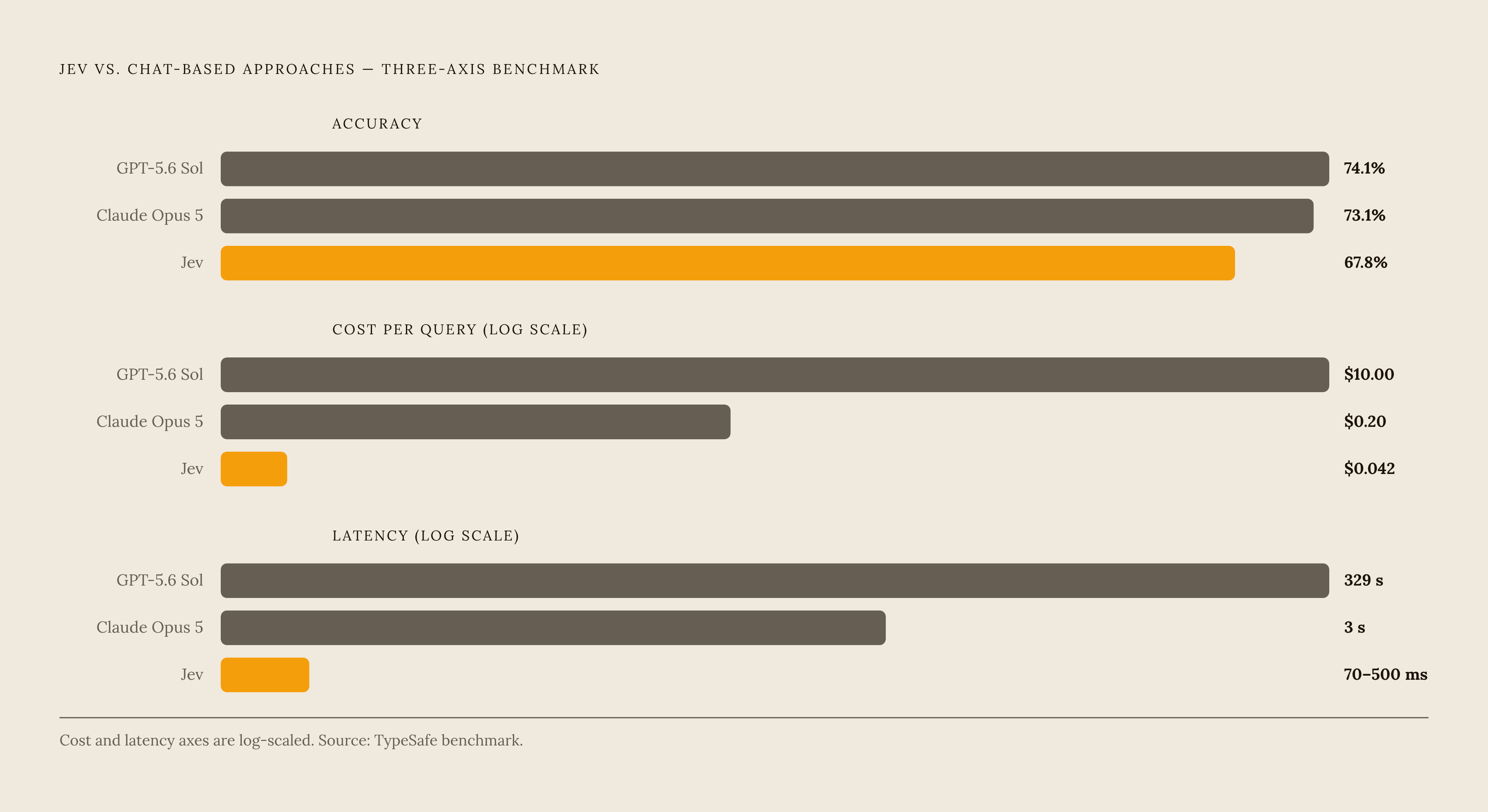
TypeSafe's own numbers come from its internal dashboard and founder statements. Independent benchmarks did start appearing from third parties in September 2026, but no fully independent benchmark of Jev existed at launch, which matters when reading any of the figures below.
TypeSafe's own four-workflow benchmark puts Jev at 67.8% accuracy, trailing GPT-5.6 Sol (74.1%) and Claude Opus 5 (73.1%) by a handful of points, at roughly a two-hundredth of the cost and a fiftieth of the latency of those larger models. Pricing runs at $0.042 against a stated range of $0.20 to $10 for comparable chat-based approaches.
Third-party testing tells a more layered story. A LiteLLM benchmark found Jev classifying requests several times as fast as Haiku by median latency, though that measured speed of classification only, not the quality of the answers produced. An independent test from AYAutomate found Jev running 2.0 to 3.6 times faster at the median and 4.7 to 7.5 times cheaper than the two cheapest small models it tested against, with accuracy roughly comparable to those small models rather than ahead of GPT-5.6 Terra; on a 77-way intent routing task, Terra actually beat Jev by 5 points, and the 193.6x figures TypeSafe advertises elsewhere didn't show up against these particular baselines.
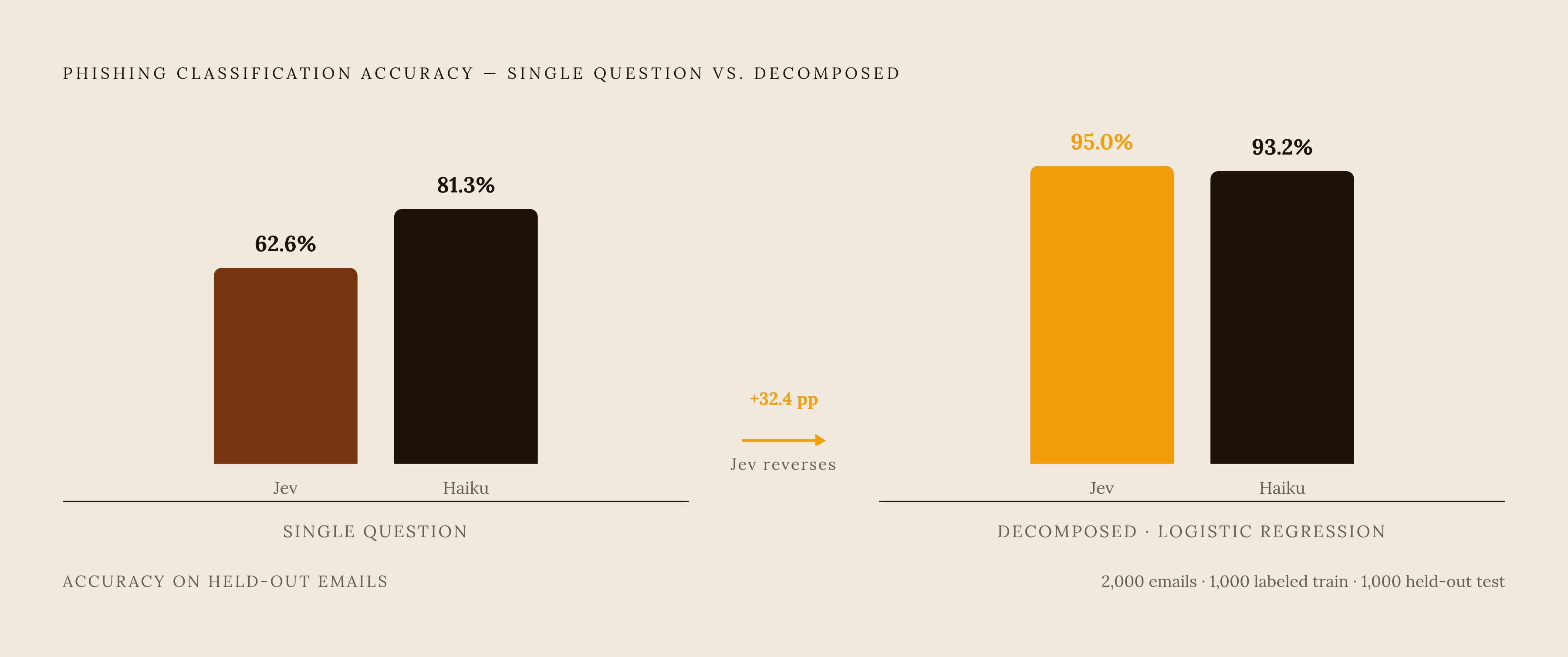
The most telling result comes from a phishing classification test run by THE DAILY BRIEF on a 2,000-email dataset. Asked one broad question per email, Jev scored 62.6% against Haiku's 81.3%, a clear loss. But when the same task got broken into five narrow questions, each answered separately and then combined through a logistic regression fitted on 1,000 labeled emails, Jev reached 95.0% against Haiku's 93.2% on a held-out set of 1,000. That reversal is the whole design philosophy in miniature: Jev doesn't do well when asked to reason its way through a broad judgment in one shot. It does well when the judgment has already been decomposed into narrow, well-formed questions before it ever sees them.
The constraints that are inseparable from the design
Jev doesn't write replies, generate code, explain its own reasoning, or summarize anything. The output surface is Noul, Choice, and Score, full stop, and there's no escape hatch back into free text.
It also doesn't run agentic control flow. Jev answers closed questions that code puts to it; the program stays in charge of what happens next, what rules apply, and what side effects follow from the answer. The schema for every question has to be declared before inference happens. Jev can't be handed an open-ended prompt and trusted to decide its own answer format on the fly.
That leaves task decomposition as a requirement rather than a nicety. The phishing test makes the point concretely: one broad question underperforms a smaller competitor, while five narrow questions recombined by ordinary statistical logic outperform a competing model that had beaten it on the single-question framing. The architecture doesn't punish sloppy framing gently. It punishes it by handing the win to whichever competitor got asked a simpler question.
Jev's place in a real system and its implications for AI pipeline design
TypeSafe frames the fit using two axes: how much reasoning a task needs, from immediate to deliberative, and what kind of output it produces, from bounded to open-ended. Jev sits in the bounded-output, fast-judgment corner, tasks that call for real semantic understanding but resolve to a fixed, closed answer.
That corner covers a lot of ground already in production systems: routing a support ticket to the correct queue, flagging a safeguarding concern buried in a message, scoring the severity of a complaint before a human ever reads it. None of those tasks need prose. They need a probability a conditional statement can use immediately, and they need it fast enough not to become the slow step in a pipeline that might run at a scale no team wants to pay chat-model prices for.
Beneath the benchmarks and the architecture diagrams, Jev really argues that the industry has been asking one tool to do two incompatible jobs. Generating fluent, open-ended text and producing a calibrated, bounded decision aren't the same task wearing different clothes, they're different problems with different failure modes, and forcing both through an autoregressive text generator was always going to cost something in latency, cost, or reliability. Whether Jev's specific bet turns out to be the right one is still an open question the third-party benchmarks haven't fully settled. But the diagnosis, that decisions and prose don't belong in the same pipeline, is hard to argue with once it's stated.