JEV Safety and Alignment Approach
Jev's constrained outputs and calibrated confidence aim to fix safety flaws baked into LLM training.

Most LLM safety work today is applied after the fact: a guardrail here, a refusal prompt there, a content filter bolted onto a model whose training never treated safety as something to optimize for directly. That arrangement holds up fine in a demo and falls apart the moment a failure actually carries weight, because the underlying model was never built to know when it doesn't know something. Sycophancy, hallucination, jailbreaks, and concealed uncertainty aren't edge cases that slipped through testing. They follow from how these models are trained and what they're asked to produce. A model that generates open-ended text can say anything, including a wrong answer delivered with total confidence, and a filter applied after generation reads the same untrustworthy signal the model produced in the first place, leaving that gap unclosed.
Reinforcement learning from human feedback, the dominant method for post-training today's large models, makes the problem worse in a specific, measurable way. RLHF rewards the answers human raters prefer, and human raters tend to prefer confident, consistent, average-sounding answers over nuanced or hedged ones. The training process punishes unusual responses and collapses the model's range toward a single safe register, a phenomenon researchers call mode dropping. A model trained this way loses the ability to say "I'm genuinely not sure" in a way that means anything, because expressing real uncertainty was optimized out of it along the way. The model cannot reliably tell its own correct answers from its wrong ones, and its confidence scores bear no fixed relationship to whether the answer is actually right. For a one-off creative task, that's a tolerable flaw. For a system making the same category of decision thousands of times a day in a safety-relevant pipeline, it's disqualifying, and no amount of prompt engineering changes that, because the defect sits in the training objective, not the wording of the question.
What Jev is and its first structural departure
TypeSafe AI launched Jev on September 15, 2026, and the model does not generate text at all in the conventional sense. It returns a typed, probabilistic decision: a choice from a predefined list, a number, or a yes or no, each one attached to a confidence score. TypeSafe classifies Jev as a System One model, a category it treats as distinct from generative LLMs, built on a new model architecture, a parallel sampler, and a training method called Reinforcement Learning for Calibrated Decisions, or RLCD.
The output format is the first real architectural break from the pattern described above, and the logic behind it is straightforward. Because the space of possible answers is fixed by the schema before the model ever runs, Jev cannot produce a type error. Whatever it returns is mathematically constrained to a member of the set the schema defines. That constraint is where TypeSafe's "can't hallucinate" claim comes from, and it needs to be read carefully: schema conformance means Jev cannot generate an answer that falls outside the defined type, though it does not mean the answer it picks within that type is correct. A model can be perfectly schema-compliant and still choose wrong. The safety value here is narrower than the marketing language suggests, but it is not trivial: a team can take a safety policy, express it as a set of typed questions, and get a zero-shot classifier running against live traffic with no policy-specific fine-tuning and no labeled training set required to get started.
How RLCD addresses the training-level cause of miscalibrated confidence
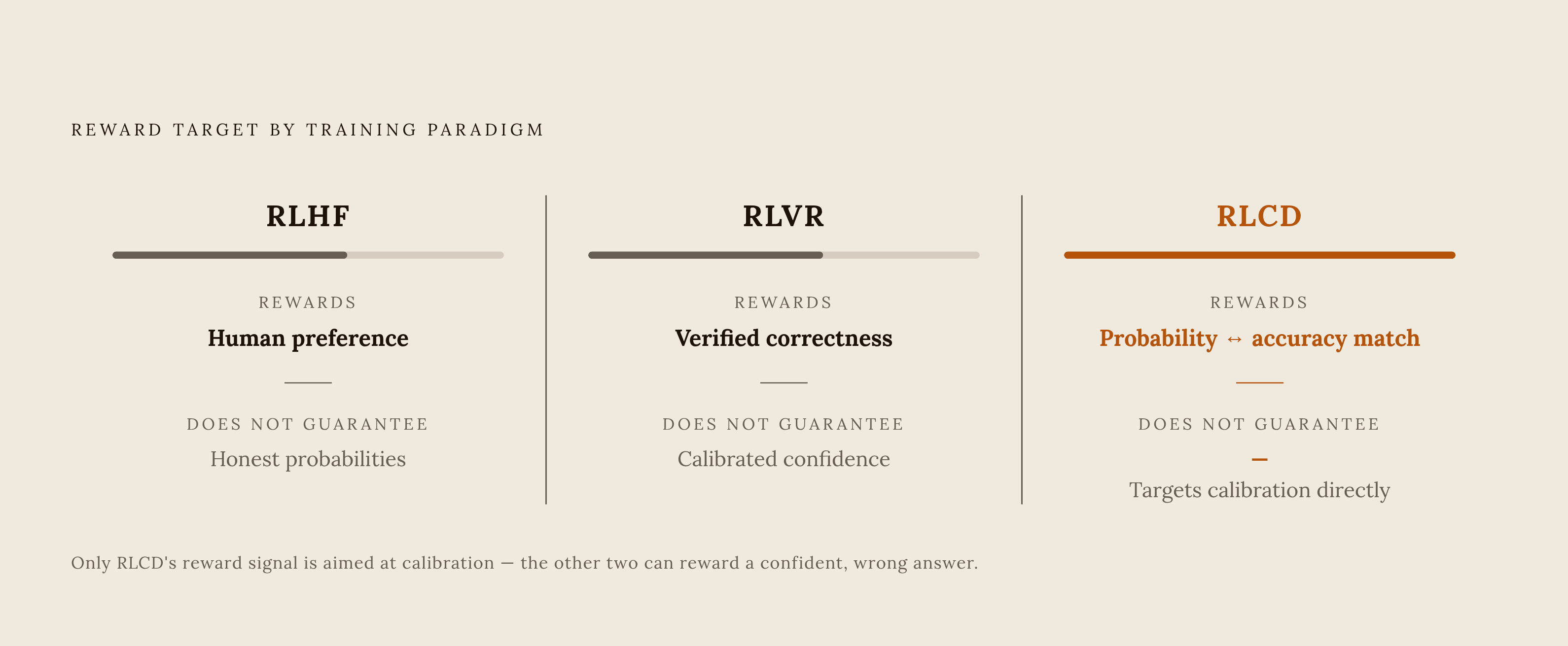
A constrained output format doesn't by itself fix miscalibrated confidence. What matters is whether the probability a model states actually tracks how often it turns out to be right, and getting that right requires changing what the model is rewarded for during training, not just what shape its answers take.
TypeSafe's RLCD, a term coined in September 2026, is a reinforcement learning post-training method where the reward depends on whether the model's stated probability matches its empirical accuracy on decision tasks. That's a different target from the two dominant post-training paradigms in use elsewhere. RLHF rewards the outputs human raters prefer. RLVR, reinforcement learning from verifiable rewards, rewards outputs a program can check against a known answer. Neither one is built to produce honest probabilities; both can produce a confident, fluent, wrong answer and reward it just the same, as long as it reads well or passes a check unrelated to calibration. RLCD targets the mode-dropping effect directly: where RLHF flattens a model's uncertainty expression toward one safe average response, RLCD makes calibration itself the thing being optimized for during training, rather than something a team hopes shows up afterward as a side effect of other objectives.
TypeSafe has published the objective behind RLCD but not the implementation. The goal, that reward should track the gap between stated confidence and actual accuracy, is public. The specific mechanism by which TypeSafe trains toward that goal is not documented anywhere available, a gap in transparency that matters for anyone trying to reason about how the method might fail. But the structural claim built on top of it stands independent of the implementation detail: a model trained to be wrong in a calibrated way, meaning its confidence scores reliably track its error rate, gives practitioners something to act on. A probability from such a model should correspond to roughly how often it's actually correct, which is not a property text-generating models offer, since their confidence language is disconnected from whether they're actually correct.
Independent testing of Jev's alignment detection in practice
The strongest evidence that RLCD does what TypeSafe says it does comes from outside the company. Guo et al., published as arXiv:2609.29429 on September 24, 2026, is the first empirical study of an RLCD model like Jev applied to the specific task of detecting alignment failures, providing the clearest external check on Jev's safety claims so far.
The researchers built a benchmark called RLCDAlignBench, testing Jev as a zero-shot detector across 44 separate benchmarks spanning ten categories of alignment failure: sycophancy, jailbreaks, deception, prompt injection, hallucination, privacy violation, social bias, reward hacking, concealing uncertainty, and power seeking. The benchmark's design responds to something true about many of these failures: they're relational. Whether a response counts as deceptive or sycophantic often depends on a reference point outside the response itself, like what the user already believed or what instruction got injected into the prompt, information the output alone doesn't carry. To isolate what's actually driving detection performance, the study varied the wording of the questions Jev was asked separately from the context it was given, so the two sources of signal could be measured apart from each other.
The headline result: a single generic question reached a median AUROC of 0.886 in a zero-shot setting, beating supervised baselines built specifically for these tasks on most benchmarks. An AUROC near 0.886 means Jev is reliably ranking failure cases above non-failure cases across a wide range of alignment problems, using one general-purpose question format, without any task-specific training. For a team trying to triage traffic at scale, that translates into a usable ranking signal for deciding what needs a closer look, not just a binary pass or fail. The study also found that question wording made little difference to performance, while context, mainly fields that directly encoded the label, mattered considerably more. Teams don't need to spend much time engineering clever prompts to get strong detection out of Jev; the context given to the model does more work than how a question is phrased. On cost, Jev matched the reference scorer's agreement with human labels while costing 63 times less than LLM-judge scorers, a gap wide enough to change what gets screened at all: at that price differential, Jev becomes viable as a first-pass filter across volumes of traffic that would otherwise go unscreened entirely because a generative judge would be too expensive to run on everything.
Accuracy, Latency, and the Competitive Field in a Real Deployment Test
Academic benchmarking establishes that the approach works in principle. Industrial deployment testing shows how it holds up against named alternatives under real operating constraints, and the clearest data point here comes from Cisco. Cisco's AI Security team published a direct deployment test on October 5, 2026, fine-tuning a parameter-efficient encoder model against harm categories drawn from the Cisco AI Security Framework, then measuring both accuracy and latency head-to-head against Jev. That comparison puts Jev against a model purpose-built and fine-tuned for a specific, named safety taxonomy, making it the strongest real-world evidence available for how Jev performs outside a controlled academic benchmark.
Red Hat's benchmarking, published October 2, 2026, adds a second real-world comparison and shows the field moving. Red Hat found that the Nemotron-3.5-Content-Safety model trailed Jev's accuracy by only a narrow margin while holding a significantly lower median latency. Taken together, the Cisco and Red Hat results suggest the accuracy gap between Jev-class models and specialized, purpose-built alternatives is narrowing, and that latency, not accuracy, is becoming the more interesting axis of competition. That framing matters for how a team should think about deployment: the choice isn't whether Jev is better or worse than every specialized model in the abstract. The choice is where in a pipeline the trade-off between cost, speed, and accuracy actually pays off, which is a gating-architecture question rather than a question of finding one model to replace everything else.
Where Jev's safety guarantees stop
Jev's safety properties are specific and bounded, and the boundaries matter as much as the properties themselves. Calibration holds up well in aggregate but not evenly across every slice of a workload. At the extremes, a very high or very low stated confidence, Jev's scores are trustworthy. In the middle range, where most real-world decisions actually fall, the scores are less reliable, and an independent study found calibration error there well above the noise floor at the benchmark level. That's exactly the range where most production decisions sit. The part of the confidence scale practitioners will lean on most is the part with the weakest guarantee.
The "never hallucinates" claim needs a precise correction. What Jev actually guarantees is schema conformance: it cannot return an answer outside the type it was asked for. It does not guarantee the answer inside that type is correct. TypeSafe's own case would be stronger stated as "type-safe with calibrated confidence" rather than framed as hallucination-free, because the second phrasing implies a correctness guarantee the architecture doesn't make.
Adversarial robustness remains an open question. Prompt injection and adversarial phrasing can distort Jev's probability outputs, and TypeSafe's own limitations documentation acknowledges this directly. Any deployment exposed to adversarial input, anything facing the open internet or untrusted users, carries risk the architecture doesn't resolve on its own.
The independence of the evidence base matters just as much. As of September 22, 2026, several independent third-party benchmarks of Jev existed, but published performance metrics up to that point originated entirely from TypeSafe AI itself. The Guo et al. study is a genuine independent check, but it's independent specifically on alignment failure detection. Broader claims about Jev's general capability and calibration haven't had the same level of external verification. And within the Guo et al. results themselves, the calibration story is more qualified than a single headline number suggests: median per-benchmark expected calibration error came in at 0.168 against a perfect-calibration floor of zero, meaning Jev's probabilities are calibrated when pooled across all 44 benchmarks but not reliably calibrated within the distribution of any single one. A team relying on Jev's confidence scores for one narrow, specific task is relying on a weaker guarantee than the aggregate number implies.
Deploying Jev's architecture as a safety layer rather than a complete safety system
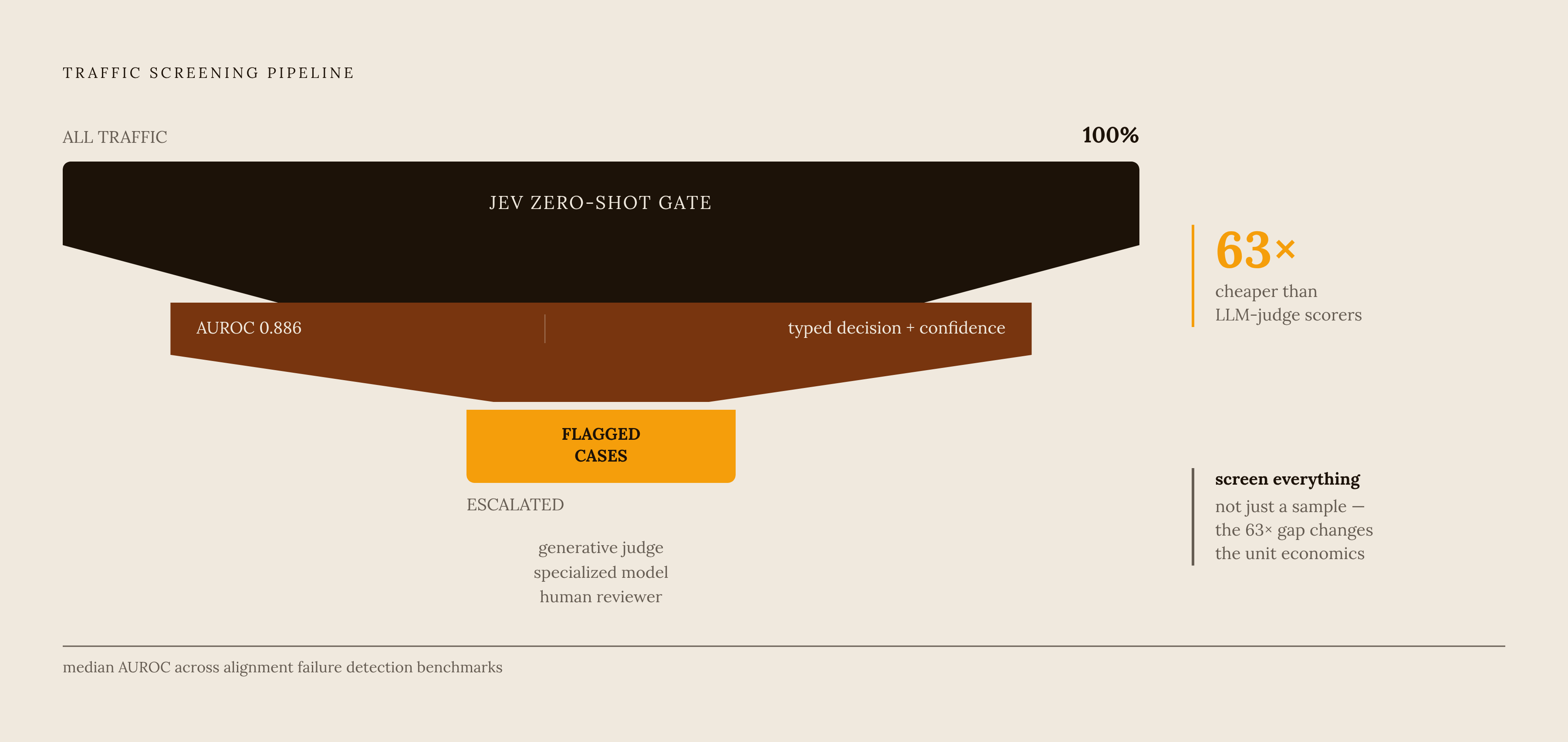
Everything above points toward one sound way to use this architecture: as a high-volume first-pass gate, not a final judgment. A team writes its safety policy as a set of typed questions, runs Jev zero-shot across all incoming decisions, and routes flagged cases to a more expensive downstream review, whether that's a generative judge, a human reviewer, or a higher-cost specialized model. The cost asymmetry documented by Guo et al., 63 times cheaper than LLM-judge scorers while matching their agreement with human labels, is what makes this architecture economically workable at scale: gating cheaply before a decision ever reaches a costlier model changes the unit economics of running safety review across an entire traffic volume.
Threshold validation on a team's own workload isn't an optional step; TypeSafe itself recommends it, because distribution shift can undermine calibration that looked solid on a benchmark but doesn't transfer cleanly to a different population of inputs. A confidence threshold tuned against RLCDAlignBench's 44 benchmarks is not automatically the right threshold for a specific company's traffic, and skipping that validation step means trusting a number that was never tested against the data it will actually be judging.
The context-matters finding from Guo et al. carries directly into how a team should build its input pipeline. Deployable reference context, a goal prompt, a list of protected attributes, meaningfully raises detection AUROC on relational failure types like deception and privacy violation. That means the fields fed into Jev deserve more design attention than the wording of the question itself, a reversal of where most teams default their effort when building a classifier.
The architecture's reach extends past alignment monitoring specifically. A study used Jev to convert police crash narratives into probabilistic crash variables at scale, an early example of the same typed-decision approach applied to structured extraction from unstructured, safety-relevant text, well outside the alignment-detection use case the rest of this piece has focused on. Teams planning high-volume deployment also need to account for Jev's documented API rate limits, which cap both requests per minute and token throughput, a practical constraint on how much traffic can run through the gate at once regardless of how well the model performs on any given request.
None of this answers whether Jev replaces human judgment in a safety pipeline. It answers a narrower, more useful question: whether human judgment becomes cheaper to deploy at the one point in the pipeline where it's actually needed, once a calibrated, typed first-pass gate has already done the work of sorting the routine decisions from the ones that deserve a closer look.
Sources
- Just Ask Jev: Reinforcement Learning for Calibrated Decisions as a Zero-Shot Detector of AI Alignment Failures
- Benchmarking AI decision models against traditional guardrails
- Jev: Decision Models on Trial - Cisco Blogs
- Just Ask Jev: Reinforcement Learning for Calibrated Decisions as a Zero-Shot Detector of AI Alignment Failures
- Under review as a conference paper at ICLR 2027 JUST ASK JEV:
- What is Jev? TypeSafe AI's System One decision model
- JEV as a Judge for Agent Trace Security:An Empirical Comparison with Generative LLM Judges